Saudi Arabia’s King Khalid International Airport in Riyadh has been struck three times this week, leaving at least 12 people dead and more than 300 wounded in the attacks.
LEADERSHIP reports that Yemen’s Iran-backed Houthi rebels have claimed responsibility for the strikes, which have reportedly affected nationals of eight countries.
The group has warned airlines against using Saudi airspace, declaring it a zone of military operations following a recent offensive by Yemen against the rebels.
The United States is among several countries urging its citizens to avoid travelling through King Khalid International Airport as security concerns mount and airlines suspend flights.
The attacks have triggered international condemnation from the United States, the United Nations, the European Union and several governments, while raising concerns about a possible expansion of the conflict.
US President Donald Trump has said Washington is considering whether to join Saudi Arabia’s military campaign against the Houthis, although no final decision had been announced in reports available as of Monday, October 12.
Latest Casualties From Saudi Arabia Airport Attacks
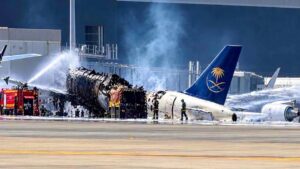
A Saudia pilot was killed and one of the airline’s aircraft was damaged during a ballistic missile attack on October 8, the Saudi Arabian national flag carrier confirmed.
The airline identified the deceased as Captain Hamoud Ali al-Kalthami. It said the aircraft was parked at the airport and had no passengers on board at the time of the incident.
Local and international media reported that a Saudia Airbus A320 sustained extensive damage and caught fire while parked near a terminal. Reports citing sources familiar with the incident said the damage could have resulted from falling missile debris or a direct projectile strike.
Saudi authorities subsequently reported that an attack on King Khalid International Airport on Saturday, October 10, killed at least 12 people and injured more than 300 others.
The victims reportedly included nationals of eight countries, highlighting the international consequences of the attacks.
A separate attack on Sunday, October 11, reportedly killed one person and injured 11 others at the airport complex, prompting further security concerns and disruptions to airport operations.
The repeated strikes have raised questions about the effectiveness of Saudi Arabia’s air defence systems and the protection of civilian infrastructure against missile and drone attacks.
Saudi authorities and the Saudi-led coalition have continued to assess the damage and investigate how the projectiles reached the airport.
White House Reacts As Trump Considers Military Action
The United States has condemned the attacks, particularly after an American citizen was reportedly among those killed in the strike on Riyadh airport.
President Donald Trump described the incident as a “terrible” attack and said Washington was considering whether to join Saudi Arabia’s offensive against the Houthis.
“We may. We’re gonna look at it. We just found out about the recent attack, so we’ll make a decision. We’ll move very quickly,” Trump said, according to Al Jazeera’s report on the international reaction.
The US president also indicated that he intended to speak with Saudi Crown Prince Mohammed bin Salman about the situation.
US Secretary of State Marco Rubio condemned the attacks, saying innocent people, including an American citizen, had been killed.
“We stand with the Kingdom of Saudi Arabia and its people and extend our condolences to the victims and their families,” Rubio wrote on X.
The US Embassy in Saudi Arabia also warned American citizens to exercise extreme caution when using the kingdom’s airports following the attacks.
As of Monday, October 12, Trump had publicly indicated that his administration was weighing possible military involvement. However, reports available at the time did not establish that the White House had announced a final decision to join Saudi Arabia’s campaign.
Airlines Cancel Flights As Riyadh Airport Faces Disruptions
The attacks and security warnings have forced international airlines to suspend or adjust flights to Saudi Arabia, leaving passengers facing cancellations, delays and uncertainty over their travel plans.
Lufthansa suspended flights to Riyadh until October 16, while Air France-KLM extended its suspension through the end of October, according to reports.
Etihad Airways suspended flights to Saudi Arabia until October 13, while India’s IndiGo cancelled services to Riyadh and Dammam until October 15.
Air India Express also suspended some services to Saudi destinations, while other airlines announced temporary changes to their schedules.
The suspension dates reflect the airlines’ announced plans at the time of reporting and may change as the security situation develops.
The disruption could affect passengers travelling between Africa, Asia and Europe, particularly those relying on Riyadh for connecting flights.
Travellers have been advised to check directly with their airlines before leaving for the airport and to monitor official travel advisories for updates on flight cancellations, diversions and alternative arrangements.
Countries Condemn Saudi Arabia Airport Attacks
The attacks have drawn condemnation from governments and international organisations concerned about the safety of civilians and the threat to regional stability.
Turkey, Pakistan, Egypt and Saudi Arabia jointly condemned the attacks, describing them as a dangerous escalation that could threaten regional and international peace.
The United Arab Emirates also condemned the strikes and expressed solidarity with Saudi Arabia.
Qatar, Jordan, Oman, Palestine, Syria, India, Japan, Canada and Malaysia were among other countries that condemned the attacks or expressed support for the kingdom.
United Nations Secretary-General António Guterres expressed shock over the deadly attack, stressing that assaults on civilians and civilian infrastructure violated international law and must cease immediately.
The European Union also expressed solidarity with Saudi Arabia, while the African Union Commission condemned the attack and called for an immediate cessation of hostilities.
The reactions reflect growing international concern that continued strikes could further destabilise the region and threaten civilian aviation and international transport routes.
Why Are The Houthis Targeting Saudi Arabia?
The attacks come amid renewed fighting involving Yemen’s Houthi rebels and forces aligned with the country’s internationally recognised government.
The Houthis control large parts of Yemen and have repeatedly targeted Saudi territory during periods of heightened conflict. Saudi Arabia has supported the Yemeni government through military operations against the rebels.
The latest strikes have brought civilian aviation infrastructure into the centre of the confrontation, raising concerns about further attacks on airports and other strategic facilities.
The Houthis’ warning that Saudi airspace is a zone of military operations could force airlines to reconsider routes and suspend services if the threat persists.
Saudi authorities are investigating how the attacks reached Riyadh airport, with the findings potentially informing security measures at other airports and critical facilities across the kingdom.
The threat of further strikes has increased pressure on regional governments to prevent the conflict from escalating.
What The Attacks Mean For International Travel
Saudi Arabia is a major international travel destination, serving business travellers, tourists and Muslims travelling for religious purposes, including the Hajj and Umrah pilgrimages.
Prolonged airport closures, flight cancellations and restrictions on Saudi airspace could affect passengers from Africa, Asia, Europe and other regions.
The crisis also threatens the kingdom’s efforts to attract foreign investment, expand tourism and strengthen its position as a regional transport and business hub.
For passengers with upcoming journeys, the immediate priority is to monitor official travel advisories, confirm flight status with airlines and follow instructions from local authorities.
Travellers connecting through Riyadh should also check whether changes to their initial flights could affect onward journeys.
What Happens Next?
Saudi authorities face the immediate challenge of strengthening airport security, investigating the attacks and determining when affected operations can safely resume.
Airlines will continue to assess the security risks before restoring suspended services, while governments are expected to review travel warnings as the situation develops.
International attention is also focused on Washington, where Trump’s consideration of possible military action could have significant implications for the conflict.
With the Houthis threatening further attacks, several countries urging caution and major airlines changing their schedules, the coming days could prove critical in determining whether diplomatic efforts can contain the escalation or whether the conflict will draw additional countries into the confrontation.